by Tony Thomas
I didn’t plan to reverse course on storage. For years, my rules were simple. SSDs everywhere. NVMe when I needed more speed, and they made sense financially. That logic held until the prices started to rise.
Over the past few months, SSD and NVMe prices have been soaring (along with DRAM prices), largely due to AI data center demand and allocations. Entry-level 1 TB NVMe drives now push well past a hundred dollars, and often far past that mark.
Slower SATA SSDs aren’t much cheaper. For active system use, those prices still make sense. For backups and archives, those prices are ridiculous! I don’t need extreme speed to store data I hope I will never have to touch.
That’s what made me stop and reassess. As a result, I have decided to move my backups and long-term storage back to spinning hard drives.
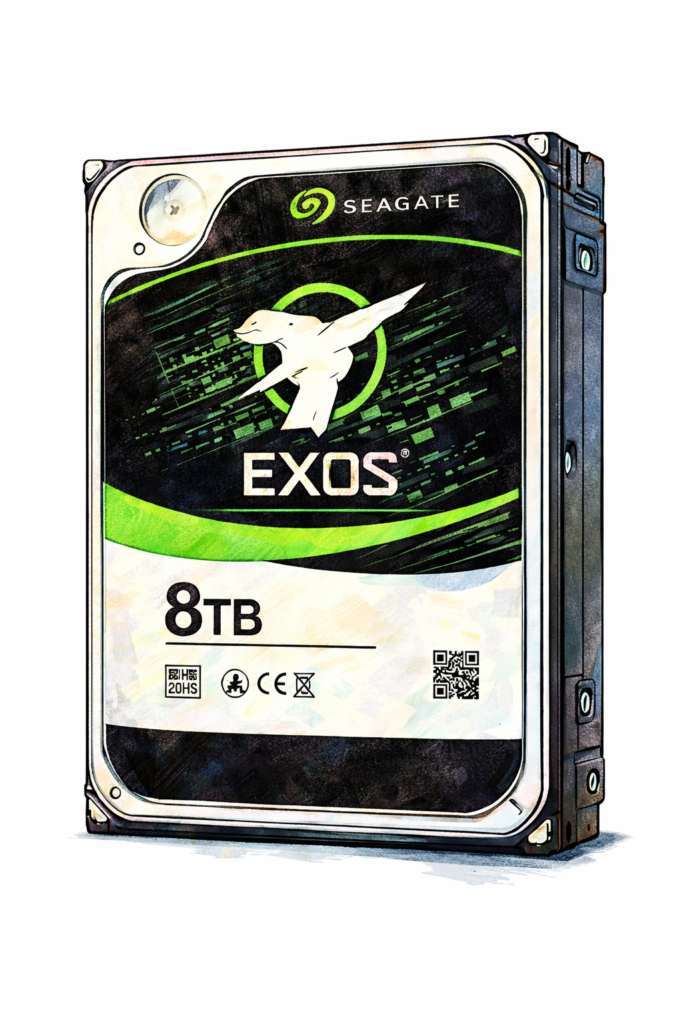
It wasn’t just a thought experiment. I started buying hard drives again. A used 8 TB Seagate Exos that once lived in a data center. A new 4 TB Seagate IronWolf 5400 RPM NAS drive. A 2 TB WD Blue at 5400 RPM.
Then, I looked around my office and noticed the obvious. I have several old desktops sitting idle with perfectly usable 3.5-inch drives inside them. It was storage I’d written off without thinking. When prices rise, your definition of waste changes quickly.
The real shift was separating performance from storage. My operating systems, apps, and active projects still live on NVMe and SSDs. That hasn’t changed.
But backups, disk images, media libraries, and cold project archives don’t need that speed. What is important are capacity, reliability, and reasonable cost per GB. And that’s where 3.5-inch hard drives still make sense.
A lot of people still backup to portable 2.5-inch laptop disks because they are compact, store easily, are bus-powered, and inexpensive. However, compared to 2.5-inch drives, 3.5-inch disks are simply better archival tools. They run cooler.
They handle long, sustained writes better. They scale to higher capacities with fewer tradeoffs. Laptop-sized drives are built for power savings, ruggedness, and portability. Desktop-class drives are built to sit still and spin for years.
And then there’s the CMR versus SMR debate, which matters more than most people admit. CMR writes data cleanly and predictably. SMR overlaps tracks to save space, then punishes you with slower speeds during rewrites. Backups rewrite data constantly.
That makes SMR a bad match for archival storage (even though I plan to use the cheap WD Blue SMR I bought for a scratch drive).
Enterprise and NAS-class CMR drives are much better choices for this kind of work. They are designed for long write sessions, extended uptime, and graceful error handling. They have high MTBF, and TB written per year specs.
That’s why they cost more than bargain consumer drives. It is also why they survive heavy workloads better.
Buying used enterprise drives sounds risky until you take a closer look. Many come from data centers with controlled power, cooling, and monitoring. They are “burned in” and stable by the time you get them, with plenty of hours left.
I’ll take a drive with known hours and a predictable past over a cheap consumer model built to hit a price point, and that may fail early in life, especially for secondary archival storage.
The unexpected part is how liberating it feels to have TBs of free space. When backups are expensive, you make bad choices. You back up less often. You keep fewer versions. You debate whether something is worth saving.
Cheap bulk storage removes that friction. I can keep multiple copies, rotate them properly, and stop cutting corners.
Hard drives aren’t immune to price pressure. That’s obvious. Manufacturers are seeing increased demand and are chasing margins, and HDDs aren’t the bargain they once were.
In fact, the IronWolf drive I bought today went up $10 within hours after I bought it! As a result, you’d better start shopping before prices on HDDs start to mirror those of SSDs and NVMes. I am already seeing stockouts on the most popular SKUs.
This isn’t about nostalgia. I have to tailor my storage choices to my budget. I’ll use fast solid-state storage where speed matters, and big, boring 3.5-inch hard drives where it doesn’t. Critical data will also live in the cloud. In the midst of these storage wars, I’ll use the most cost-effective tools to protect my data.