by Tony Thomas
The golden age of advertising sure seemed glamorous. Mad Men set the tone with its scenes of smoke-filled offices, late-afternoon cocktails, and confident executives who seemed to control the culture with a wave of a hand. Even sitcoms like Bewitched played into that myth. Darren Stevens and Larry Tate spent their days pitching ideas, smoothing over clients, and heading home just in time for dinner (at the twitch of Samantha’s nose). To a young person watching from the outside, it looked like a world where creativity, charm, and quick thinking could open any door.
That image worked on me. I found my way into the advertising business because of David Ogilvy. His book (“Confessions of an Advertising Man”) was my doorway into a world that mixed intellect with persuasion, research with storytelling, and discipline with imagination. Ogilvy made the craft feel noble and exacting. His writing was superb. The idea that you could shape behavior with a single headline or a clean layout felt almost magical. By the time I decided to start my own agency in the late seventies (while taking courses at the Cleveland Ad Club), I carried Ogilvy’s lessons with me like a manual: respect the consumer’s intelligence, do your homework, and let the “Big Idea” stand on its own.
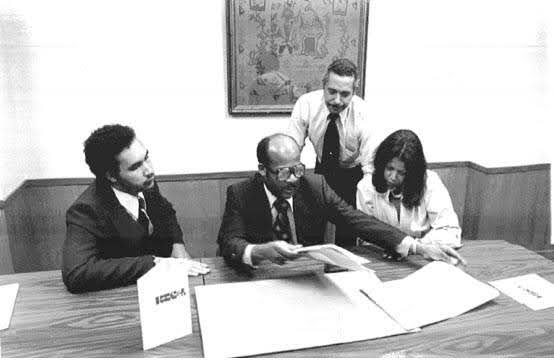
The business I entered did not match the glamor of the previous era, but it had its own energy. I co-founded a small shop in Cleveland (after a short stint as a solopreneur), serving as both account supervisor and chief copywriter. That meant I spent days in client meetings and my free time at the typewriter, creating strategic presentations and writing persuasive copy. The tools were primitive compared to today. We had an artist’s den where paste-ups covered every surface and the smell of rubber cement hung in the air. Layouts leaned against the walls. When we wanted a new version of a headline, we had to send it to the typesetter. When we needed to revise a layout, it was created by hand.
Even as a small agency, we did not stay isolated. Cleveland was a medium-sized market with many corporate HQs. As a result, we collaborated with big agencies on projects for McDonald’s, Grumman, TRW, GCRTA, and others. Those partnerships let me see how the larger shops operated. Participating in formal training sessions, presentations, and strategy sessions shaped how we approached our own work. It felt like having a seat at a much bigger table.
When I later moved to Los Angeles, I got a peek into world-class ad agencies like Ogilvy & Mather, DDB, McCann Erickson, Grey Advertising, and Chiat/Day. I made many contacts and was mentored by Monty McKinney, an LA advertising legend who graduated from Oberlin College in Oberlin, OH–the city where my Dad grew up. Monty was one of the original “Mad Men” who worked on major accounts like Volkswagen, Max Factor, Gallo Wine, and American Airlines at agencies that included Earle Ludgin & Co., DDB, Kresser-Craig, and Chiat/Day.
After some time in advertising sales in LA, I helped start a recruitment advertising agency that served clients such as Plantronics, World Airways, and SP Communications (later known as Sprint). Recruitment advertising required a different mindset. Instead of speaking to the broad public, we aimed at specific kinds of candidates. We built messages that spoke to skills, aspirations, and workplace culture. In a way, it foreshadowed the targeted communication that digital platforms would later make commonplace. As Creative Director, I was able to create effective campaigns from the ground up, including copywriting and graphic design.
After that chapter, I resumed being a solopreneur, handling advertising and public relations for smaller accounts. It gave me the chance to flex my creative muscles, develop marketing strategies, and sculpt data and result-driven campaigns. And I wrote, produced, and voiced radio spots for a wide range of clients, including other agencies. That mix kept me close to clients and grounded in the practical side of the business. Not only did I make money, but I also learned a ton.
I watched the ad business shift as well. When I started, agencies relied on media commissions. If a client bought space or airtime, the agency earned a percentage. Other work received a markup over raw cost. It was a simple and predictable fee structure. As digital media took over, that model eventually faded, and fixed-fee and performance-driven remuneration replaced it. Media buying was often given to specialized agencies that could negotiate the best deals and maximize ROI. Agencies had to justify their work with deliverables and analytics rather than relationships and reach. The simplicity of the early years disappeared and was replaced by a system that was built on measurement and accountability.
Then came Google. It redrew the map. Search ads gave brands immediate visibility. Social media companies built giant audiences and pushed print media toward the margins. Even television and radio lost their dominance as budgets shifted to platforms that promised clearer metrics and provided comprehensive analysis tools. The target audience no longer sat in one room. It was scattered across devices and had shorter attention spans. Campaigns became a stream of content instead of a single polished piece. A concept had to work in a six-second clip as well as a long-form video. Copy had to fit into narrow spaces without shedding meaning.
This shift reshaped the work itself. In my early years, a campaign might take months to develop. A television spot required crews, scripts, sets, and days in the editing room. Today, a single post can reach millions in minutes. A message can go viral or vanish before you finish your coffee. The speed is relentless. The pressure is constant. The room for reflection shrinks with each new platform that promises instant engagement.
And now the industry faces another transformation driven by artificial intelligence. AI tools can draft copy, generate images, and analyze data with astonishing speed. The creative process resides in AI-fueled computers that can produce dozens of variations from a single idea in seconds. Strategy becomes the driving force. And the job shifts from crafting everything by hand to guiding and refining what the tools produce.
Yet with all these changes, the heart of the advertising business has not really changed. It still relies on understanding people and their hierarchy of needs. It still requires clarity, honesty, and ideas that resonate. The old world had structure and craft. The new world has speed and precision. I have lived through both, and each has its own strengths.
As an advertising professional, that means holding onto the part of the business that never changes. You still need to reach someone at the right moment with the right message. The “Big Idea” has survived–from the Mad Men era to the age of AI. And it will carry the ad business into the future.